
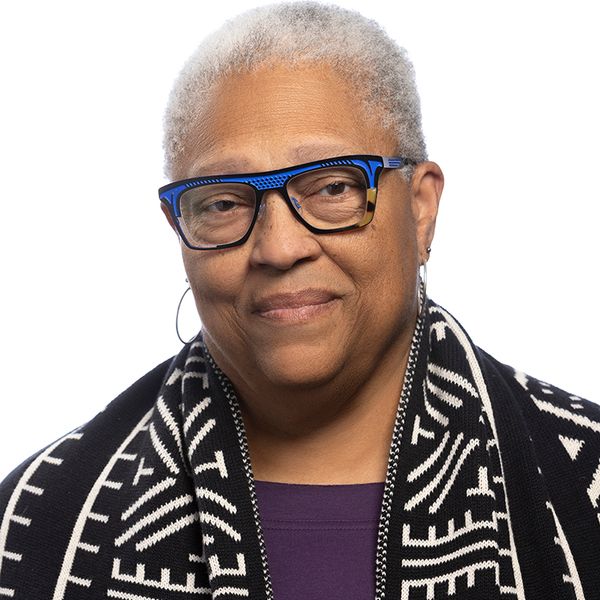
 Theologian Emilie M. Townes, an American Baptist clergywoman, will deliver the annual Candlemas Lecture on February 4 at 7 p.m. in Gasson 100. Townes is the Martin Luther King, Jr. Professor of Religion and Black Studies at Boston University. Previously, she served as dean of Vanderbilt Divinity School, where she was the University Distinguished Professor of Womanist Ethics and Society. She also has taught at Yale Divinity School, Union Theological Seminary, and Saint Paul School of Theology. She is the editor/co-editor of numerous volumes, including Walking Through the Valley: Womanist Explorations in the Spirit of Katie Geneva Cannon; Embracing the Spirit: Womanist Perspectives on Hope, Salvation, and Transformation; Faith, Health, and Healing in African American Life. She is author of several books, including Womanist Ethics and the Cultural Production of Evil; In a Blaze of Glory: Womanist Spirituality as Social Witness; and Breaking the Fine Rain of Death: African American Health Issues and a Womanist Ethic of Care. Her lecture, titled “Facing (In)Justice with the Power of Hope,” is presented by the Lowell Humanities Series and cosponsored by the Theology Department. The event is free and open to the public, but advance registration is required.
Emilie Townes presents Candlemas Lecture
Navigating illness together
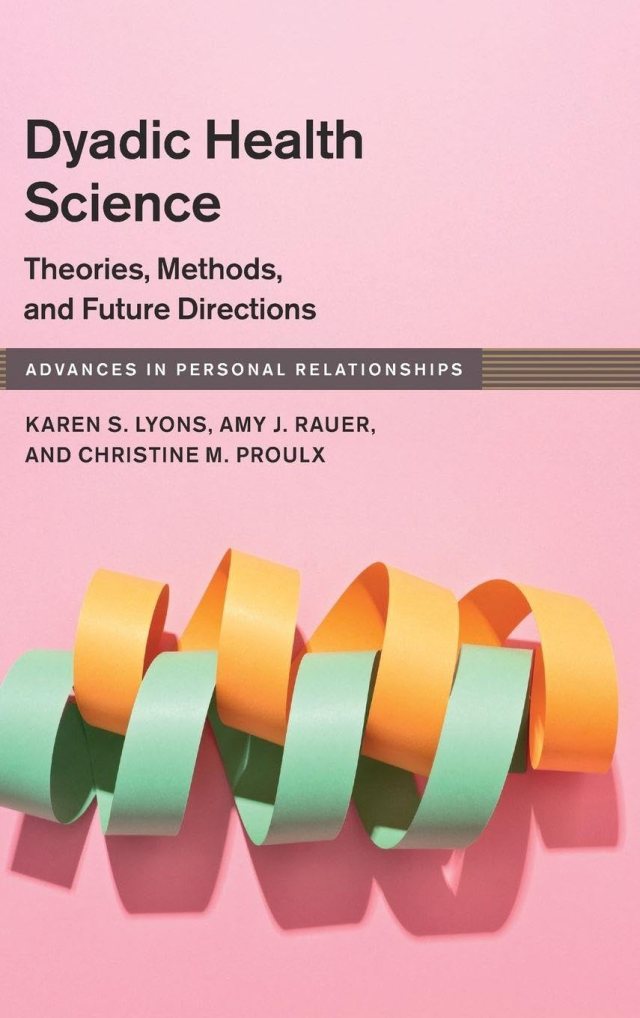 Dyadic health science—a fast-growing interdisciplinary field of health research—is the study of how people in close, personal relationships navigate health challenges and illness together. Connell School of Nursing Professor and the Elizabeth Power Keohane Faculty Fellow Karen Lyons is co-author of a new book on the subject that provides a historical overview, discussion of current challenges in the field, and tips on how to build a program of research. In Dyadic Health Science: Theories, Methods, and Future Directions (Cambridge University Press, 2026), Lyons and co-authors University of Tennessee) and University of Vermont) detail how the field has evolved over time, exploring its links to relationship science, psychology, nursing and health-related fields, family science, social work, gerontology, and the science of behavior change.
New vision for a shrinking church
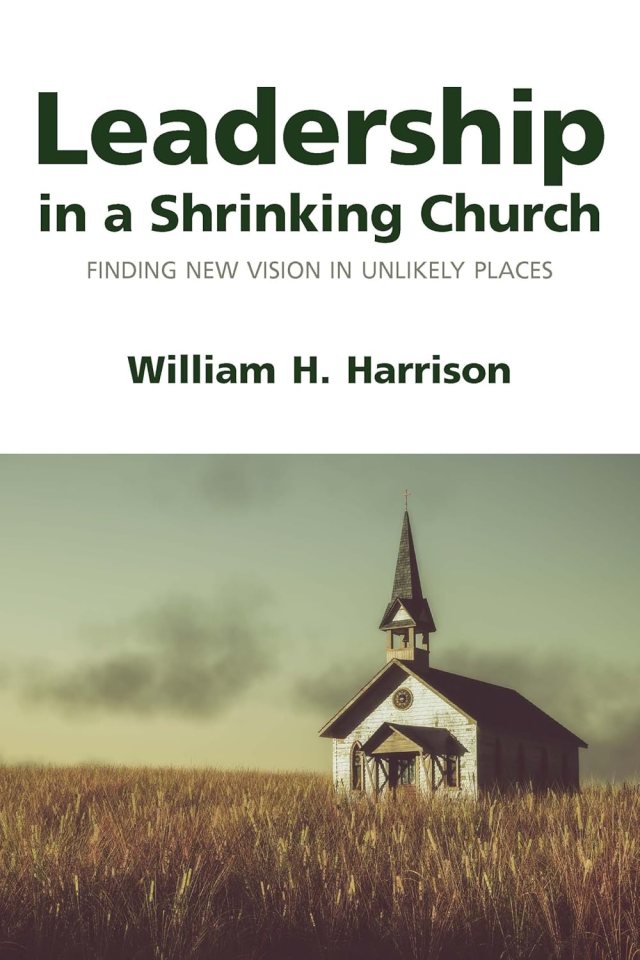 Numerous churches are contending with the challenges posed by declining membership and attendance. In his book , Boston College graduate Rev. William Harrison examines the theological and ecclesiological questions posed by a shrinking church. A Harrison argues that in response to demographic change, churches must re-imagine the purpose of church and leadership and renew their outward focus on evangelism and service. Leadership in a Shrinking Church connects theological reflection to mission by identifying some of the challenges presented by decline and connecting them to productive responses. Harrison earned a doctorate from BC in 2000. He is president of Lutheran Theological Seminary, Saskatoon, Canada. He has served in a variety of leadership and teaching roles with the church in educational, diocesan, and parish contexts.
Posted in Alumni Authors
Leave a comment
Fr. Tom book series
 Boston College graduate Jim Sano is author of the award-winning Fr. Tom book series, Catholic fiction revolving around Fr. Tom Fitzpatrick of St. Francis parish in the Boston archdiocese. The latest installment in the series, Joline, takes place outside the parish in Belfast, Maine where Fr. Tom is visiting a friend. The novel’s namesake is a 19-year-old woman who is found dead floating in the harbor. Fr. Tom helps the local sheriff uncover clues and a history of secrets as they work together to try to determine what happened to Joline. Sano, who earned a bachelor’s degree from BC in 1979, is a member of the Catholic Writers Guild.
Posted in Alumni Authors
Leave a comment
The Matilda Effect
 Margaret Knight, who invented the flat-bottomed paper bag, saw the patent go to a man who stole off to the Patent Office with her idea. Knight is just one of the women featured in Oh No He Didn’t! Brilliant Women and the Men Who Took Credit for Their Work, a book written by 1983 Boston College graduate Wendy Murphy. The author tells the stories of women artists, inventors, scientists, architects, and mathematicians who were denied their due, such as Mileva Einstein, Rosalind Franklin, and Candace Pert, among many others. Murphy is attorney specializing in women’s rights, civil rights, constitutional rights, and violence against women and children. She served as a columnist for the Boston Herald for many years and has appeared frequently on network and cable news shows as a pundit and legal analyst.
Just Watch Me
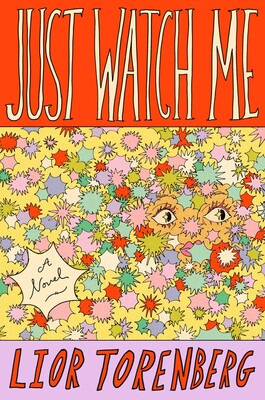 The debut novel from 2018 Boston College graduate Lior Torenberg is “a razor-sharp tragicomedy about the internet economy and a surreptitiously moving tale about the desire to be watched, and the terror of being seen.” In Just Watch Me (Avid Reader Press/Simon & Schuster, 2026), Dell Danvers starts a 24-hour live stream of her life to raise funds for her comatose sister. Narrated in seven chapters, one for each day of Dell’s live stream, Just Watch Me careens through a week in the life of this misguided striver with a heart of gold. The publisher calls Just Watch Me “a poignant and darkly funny exploration of grief, forgiveness, and redemption.” After graduating with a bachelor’s degree from BC’s Lynch School of Education and Human Development, Torenberg earned a M.F.A. in creative writing from New York University.
A bad sign
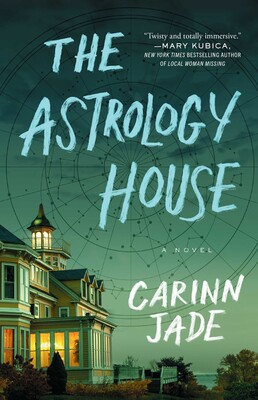 Mystery and family drama abound in The Astrology House (Atria Books), a debut novel written by 1998 Boston College graduate Carinn Jade. Stars Harbor Astrological Retreat promises rest, relaxation, and wisdom for a group of wealthy New Yorkers seeking a break from their stressful lives. With Instagram-worthy views and nightly astrology readings in an impeccably restored waterfront Victorian house, this resort should be the ultimate getaway. But Rini, the astrologer host, has a plan for her guests, and one of them won’t be leaving Stars Harbor alive.
Tuxedo Park
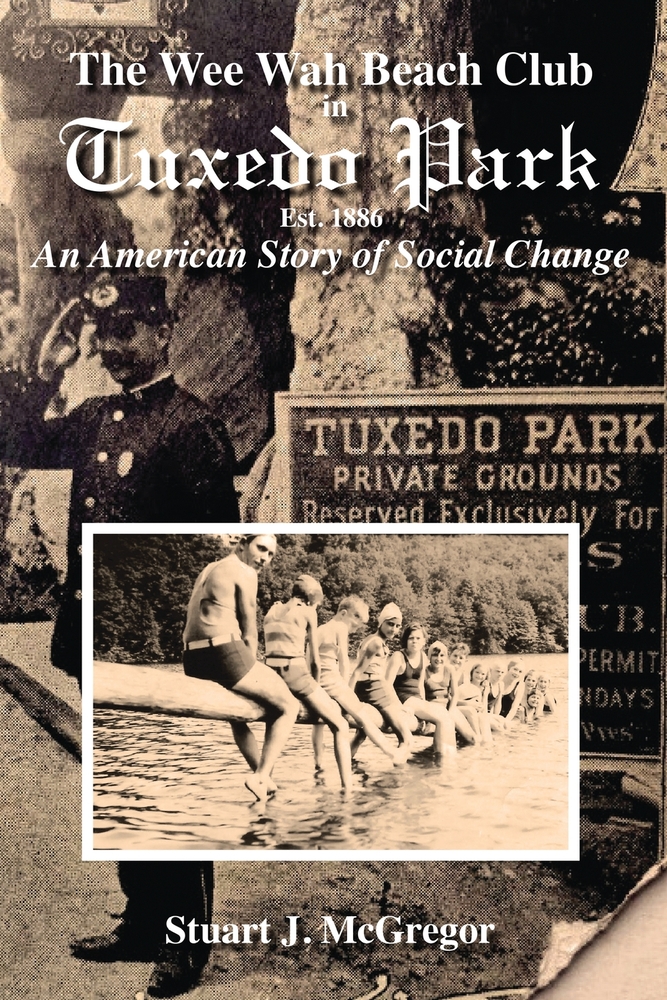 In the nonfiction book, The Wee Wah Beach Club in Tuxedo Park: An American Story of Social Change, 1966 Boston College graduate Stuart McGregor explores the history of an enclave for the wealthy of New York City that was established in 1886. Tuxedo Park was a recreational community historically occupied by those who built their mansions on 5th Avenue in New York City and Newport, and still exists today as a gated community. McGregor questions if U.S is heading into a new Gilded Age, where a there is significant disparity between the ultra-rich and other Americans.
Poet C. Dale Young
 Award-winning poet C. Dale Young, a 1991 Boston College graduate, has released his latest poetry collection—described as a “tour de force”—Building the Perfect Animal: New and Selected Poems (Four Ways Books, 2025). From the publisher: “As a tenured artist and veteran doctor, Young writes with a dual awareness of life’s fragility and the lyric’s endurance, presenting readers with new work that is entirely fresh even as it speaks to his broader legacy and dialogues with his preceding oeuvre. …[T]hese poems explore the author’s simultaneous embrace of mortality’s richness and resignation to death’s inevitable decay. Young surveys the perpetual ultimatum of his roles: as an oncologist, the patients (including his parents) he couldn’t save; as an artist, the self he intends to confront honestly as his body ages; and, as a mortal raised with stories of the Taino gods, the impossibility of building the perfect animal.” Young is the author of The Affliction, a novel in stories, and the poetry collections The Day Underneath the Day; The Second Person, a finalist for the Lambda Literary Award in Poetry; Torn, named one of the best poetry collections of 2011 by National Public Radio; The Halo, a finalist for the Lambda Literary Award in Poetry; and Prometeo.
Irish keywords
 Two Boston College Irish Studies Program faculty members contributed articles to a special edition of New Literary History, a Journal of Theory and Interpretation. The edition is focused on ‘Irish Keywords’ and marks the 50th anniversary of Raymond Williams’ iconic Keywords: A Vocabulary of Culture and Society. Sullivan Chair in Irish Studies Guy Beiner wrote an essay that explores the keyword ‘seanchas,’ an Irish term meaning vernacular knowledge of history, memory, and tradition. Professor of the Practice Robert Savage penned an essay that addresses the keyword ‘Troubles.’ This term is used to describe recent unrest in Northern Ireland and is also a keyword used to define rebellions roiling the British Empire at the conclusion of World War II. Beiner is the author of the prize-winning books Remembering the Year of the French: Irish Folk History and Social Memory and Forgetful Remembrance: Social Forgetting and Vernacular Historiography of a Rebellion in Ulster. An expert on contemporary Irish and British history, Savage is the author of several publications, including the book Northern Ireland, the BBC and Censorship in Thatcher’s Britain.
 BC Bookmarks